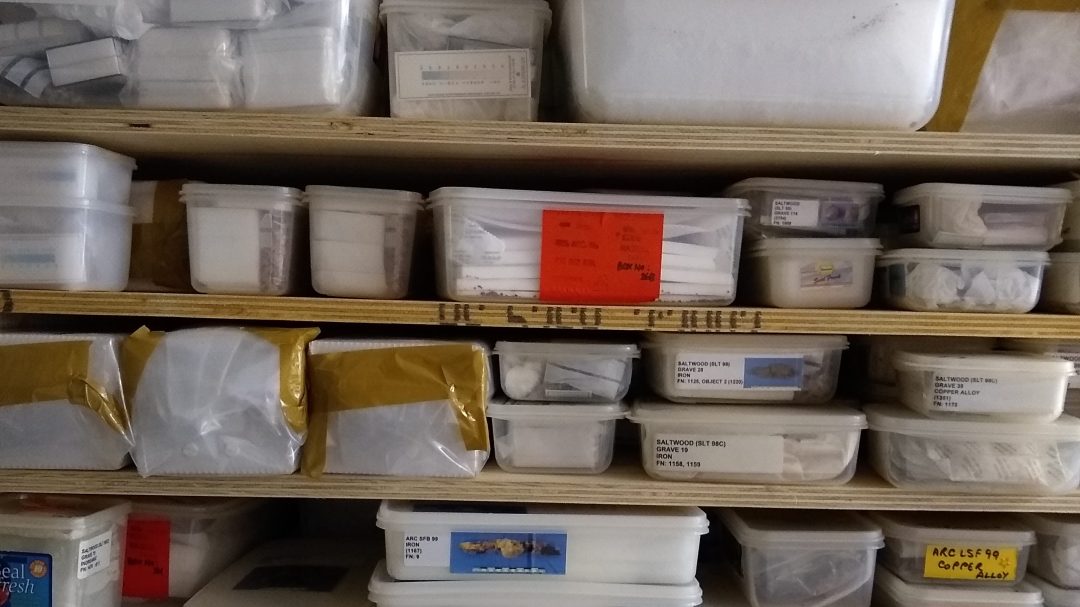
The HS1 metals archive is full of some amazing individual finds, from gilded brooches to metre-long swords. In this blog however, CSI Intern and MA History graduate Ewan talks us through the most abundant object in the HS1 archive, and how they point towards a bigger question of waste in collection storage and beyond.
Going through the HS1 archive I have come across more nails than I can count. If I am to be completely, honest the prospect of looking at another box of hundreds of nails or nail fragments does not fill me with joy. When compared to silver coins depicting the Roman Emperors Trajan and Antinous Pius, or Anglo-Saxon swords, a rusted nail seems like waste. The nails, though from a variety of origins, being Roman, Anglo-Saxon, and Medieval, tell a very human story. It shows us that despite the vast cultural and historical differences between the listed periods of British history; the people that inhabited those spaces all shared a proclivity towards the use and disposal of the nails. This is not necessarily, a habit of antiquity, as anyone from a building site will tell you. Nails, in all variety, whether used for building, dropped on purpose or by accident, are always left at construction sites.
This blog does not aim to act as a research piece into nails but hopefully it will provide some questions to consider on how we use and dispose of different objects. Looking specifically at how every generation leaves behind its own mark on the archeological landscape.
To disappoint any nail enthusiasts reading this, I am neither an expert in nails nor is this blog an allegory of the history of nails. However, this blog does aim to act as means in which I can convey my thoughts on the human nature and our impact on space we inhabit. For myself, I studied the human nature in the context of propaganda. How throughout history and cultures, the essence of propaganda does not change because the human experience at a base level does not. The emotions and thoughts we have today, are something experienced by our ancestors of two thousand years ago. The use and disposal of abundant items, like nails, as a constant throughout history, should show us that the human psyche does not change. That the Roman Colonae builders in the British provinces left waste: like our modern counterparts. Indeed, I would like to ask this question: is our proclivity as a species to create waste a recent modern phenomenon or something that has been itself a constant throughout history?
In the modern context we feel very responsible for global waste. Indeed, we blame our modern culture of consumerism on the waste produced by our society. The attractiveness of biodegradability is that we will leave no waste for the future generations. In this regard we see ourselves as unique, many of us see as something our ancestor would shun us for. Are we as a society particularly unique in our wastefulness? Or do we just have the propensity the achieve wastefulness on a grander scale?
The nails I have seen are not just those thrown away. There are many that were used for purpose, simply being what is left from the buildings they were part of. However, like a used nail on a modern building site or a plastic straw thrown away after a meal, the human nature of creating waste has not changed. If anything should be taken from this blog it is that the human psyche and spirit has never changed. Our cultural practices might change; our language and customs might evolve, even the materials and technology that we throw away might change. But that there is innately fundamental mindset that mankind has. That mindset is something we in our modern society, did not create and cannot necessarily escape from.
What do you think? Are the abundant iron nails in the archive as important as the more shiny and intricate finds? Or have we learned what we can from them and now their conservation upkeep is adding another layer of modern waste onto these historical objects? Let us know in comments!
P.S. While uploading this blog, we realised none of us have taken any photos of iron nails this whole time… coming soon!

 CSI: Sittingbourne